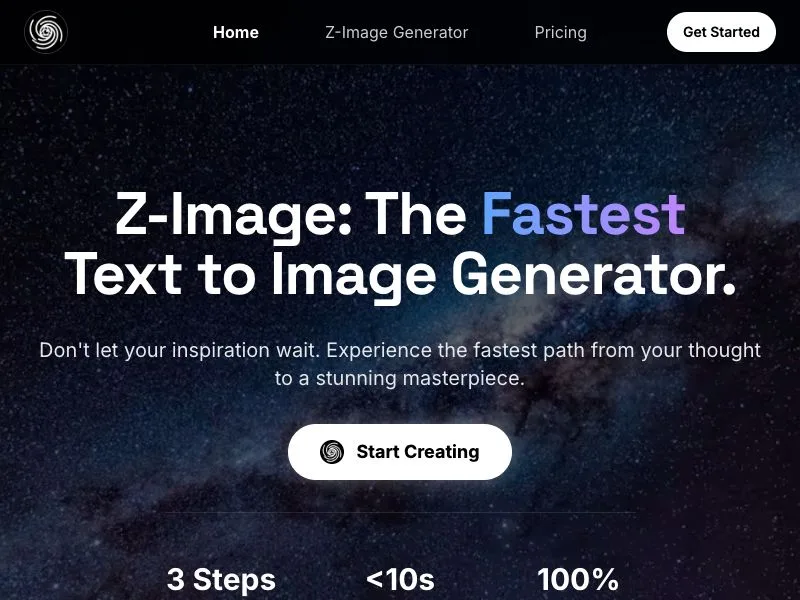
Z-ImageFlash is a web-based text-to-image generation platform built on the Z-Image Turbo diffusion model. The service converts text prompts into digital images through an 8-step neural function evaluation process, designed to reduce generation latency compared to traditional multi-step diffusion systems.
Technical Foundation
The platform utilizes Z-Image Turbo, a single-stream diffusion transformer architecture that processes text inputs through a specialized language encoder before passing them to the image synthesis pipeline. This approach differs from multi-model systems by maintaining a dedicated pathway for text-to-image conversion, which can impact both processing speed and output consistency.
User Interface and Workflow
The generation process follows a straightforward input-output model. Users enter descriptive text into a prompt field, select aspect ratio preferences (landscape, portrait, or square), and initiate the generation process. Results typically appear within several seconds, depending on server load and prompt complexity. Generated images are stored in a user gallery accessible through the dashboard interface.
Pricing Structure
Z-ImageFlash operates on a credit-based system with three tiers. Free accounts receive a limited allocation of credits upon registration, with daily usage caps and watermarked output. Paid subscriptions remove watermarks and increase generation limits, with options for monthly or annual billing. Credits are consumed per generation, with costs varying based on selected resolution and processing parameters.
Feature Set
The platform supports bilingual prompt processing in English and Chinese. Generated images can be downloaded in standard web formats, and paid tier users receive commercial usage rights for their outputs. The service includes basic prompt history, gallery organization tools, and the ability to adjust generation parameters such as aspect ratio before processing.
Technical Limitations
As a specialized text-to-image tool, Z-ImageFlash does not currently offer image editing, inpainting, or video generation features within its primary interface. The service relies on cloud-based processing, requiring an active internet connection. Generation quality depends on prompt specificity and the inherent capabilities of the underlying Z-Image Turbo model.